Abstract
Recent neural models for image captioning usually employ an encoder-decoder framework with an attention mechanism. However, the attention mechanism in such a framework aligns one single (attended) image feature vector to one caption word, assuming one-to-one mapping from source image regions and target caption words, which is never possible. In this paper, we propose a novel attention model, namely Adaptive Attention Time (AAT), to align the source and the target adaptively for image captioning. AAT allows the framework to learn how many attention steps to take to output a caption word at each decoding step. With AAT, an image region can be mapped to an arbitrary number of caption words while a caption word can also attend to an arbitrary number of image regions. AAT is deterministic and differentiable, and doesn’t introduce any noise to the parameter gradients. In this paper, we empirically show that AAT improves over state-of-the-art methods on the task of image captioning.
Attention Modules
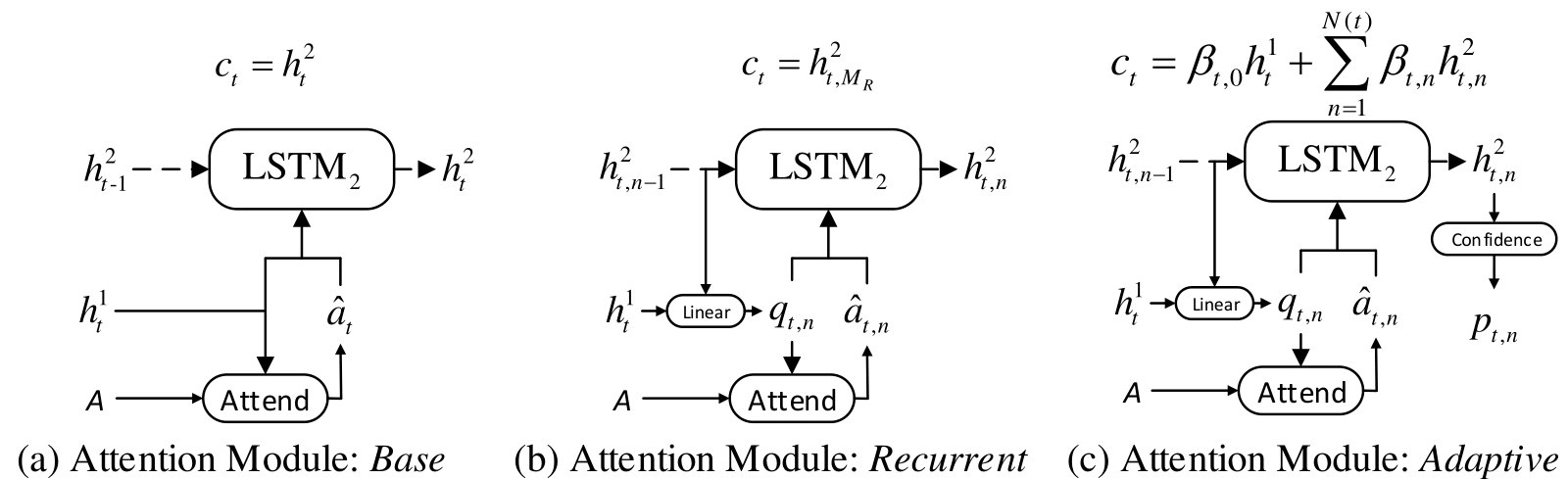
(a) Base: one attention step per word. (b) Recurrent: a fixed number of steps. (c) Adaptive (AAT): a learned, confidence-driven number of steps per word.
Qualitative Results
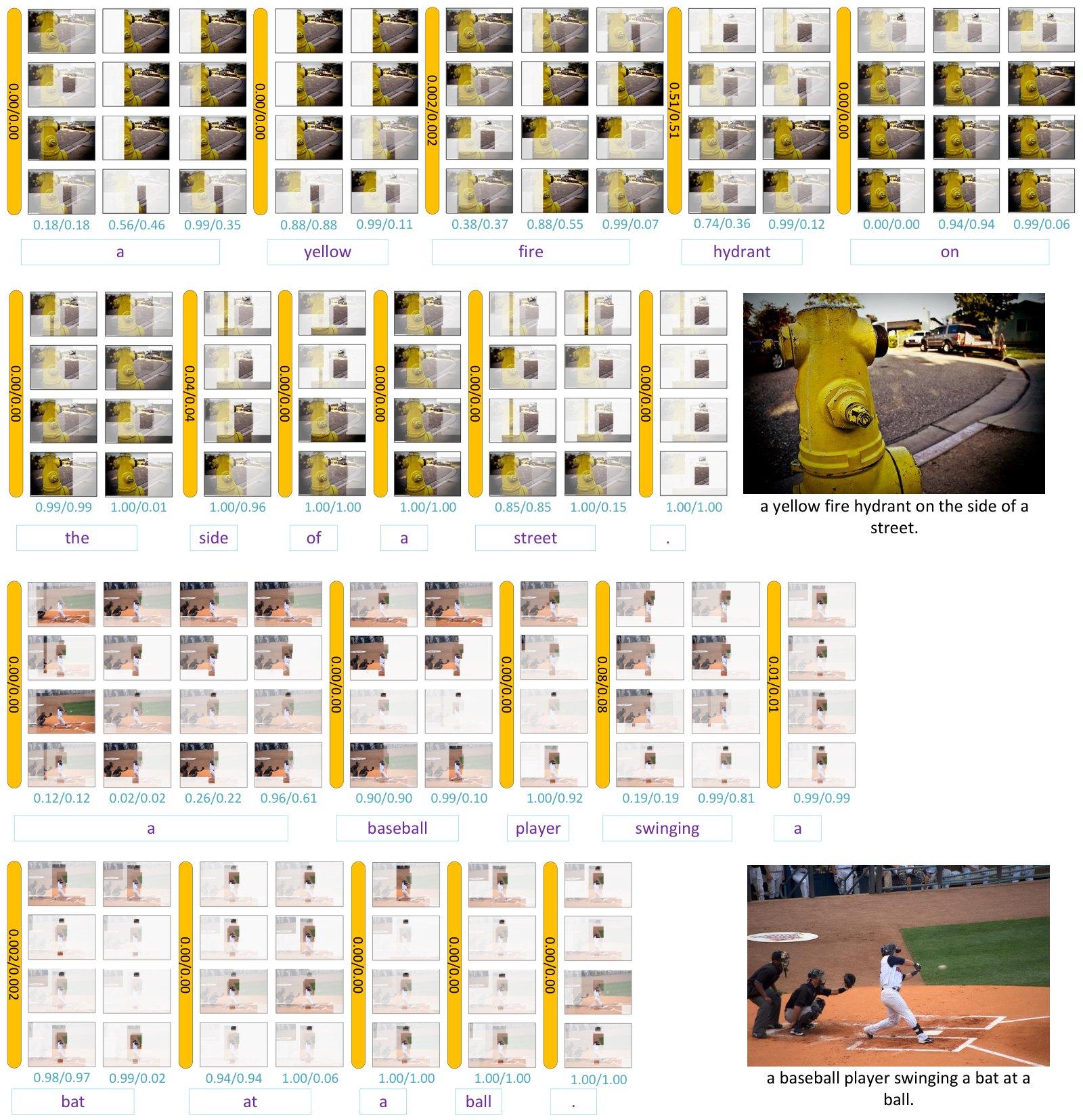
Visualization of the attention steps AAT takes while generating each caption word.
BibTeX
@inproceedings{huang2019adaptively,
  title     = {Adaptively Aligned Image Captioning via Adaptive Attention Time},
  author    = {Huang, Lun and Wang, Wenmin and Xia, Yaxian and Chen, Jie},
  booktitle = {Advances in Neural Information Processing Systems (NeurIPS)},
  volume    = {32},
  year      = {2019}
}