Abstract
Autoregressive modeling has been a huge success in the field of natural language processing (NLP). Recently, autoregressive models have emerged as a significant area of focus in computer vision, where they excel in producing high-quality visual content. Autoregressive models in NLP typically operate on subword tokens. However, the representation strategy in computer vision can vary in different levels, i.e., pixel-level, token-level, or scale-level, reflecting the diverse and hierarchical nature of visual data compared to the sequential structure of language. This survey comprehensively examines the literature on autoregressive models applied to vision. To improve readability for researchers from diverse research backgrounds, we start with preliminary sequence representation and modeling in vision. Next, we divide the fundamental frameworks of visual autoregressive models into three general sub-categories, including pixel-based, token-based, and scale-based models based on the representation strategy. We then explore the interconnections between autoregressive models and other generative models. Furthermore, we present a multifaceted categorization of autoregressive models in computer vision, including image generation, video generation, 3D generation, and multimodal generation. We also elaborate on their applications in diverse domains, including emerging domains such as embodied AI and 3D medical AI, with about 250 related references. Finally, we highlight the current challenges to autoregressive models in vision with suggestions about potential research directions.
Three Ways to Make Vision Sequential
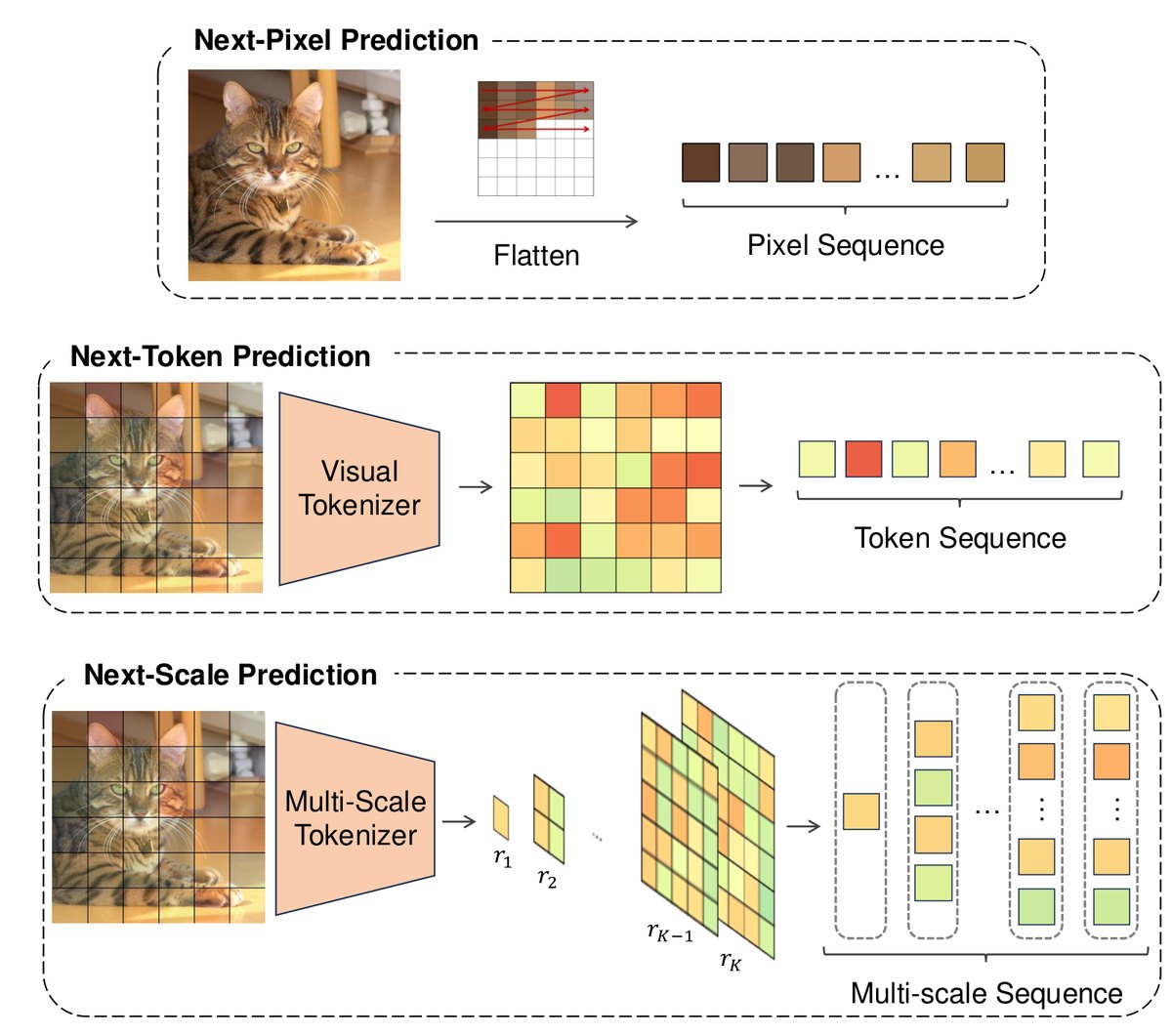
Taxonomy. Next-pixel, next-token (via a visual tokenizer), and next-scale (via a multi-scale tokenizer) prediction.
Timeline
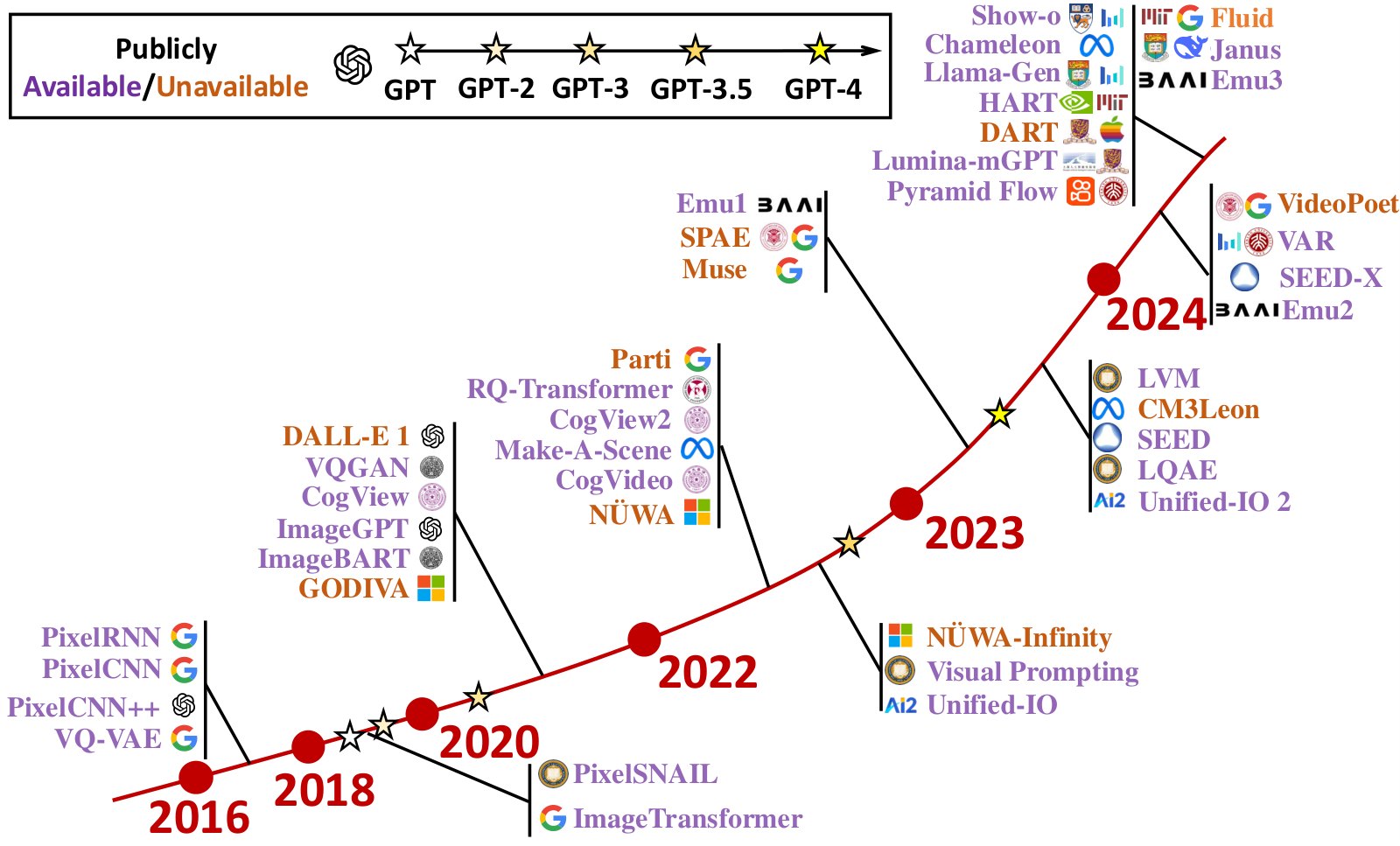
Milestones in visual autoregressive modeling from PixelRNN (2016) to 2024.
BibTeX
@article{xiong2025autoregressive,
  title   = {Autoregressive Models in Vision: A Survey},
  author  = {Xiong, Jing and Liu, Gongye and Huang, Lun and Wu, Chengyue and Wu, Taiqiang and Mu, Yao and Yao, Yuan and Shen, Hui and Wan, Zhongwei and Huang, Jinfa and Tao, Chaofan and Yan, Shen and Yao, Huaxiu and Kong, Lingpeng and Yang, Hongxia and Zhang, Mi and Sapiro, Guillermo and Luo, Jiebo and Luo, Ping and Wong, Ngai},
  journal = {Transactions on Machine Learning Research},
  year    = {2025}
}